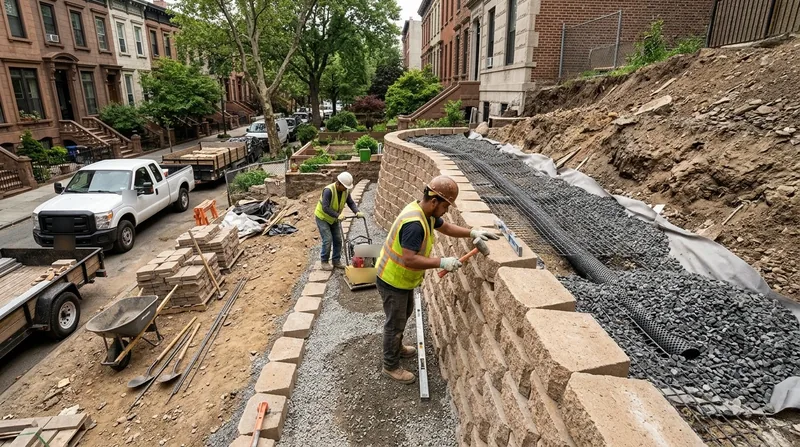




Block & Segmental Retaining Walls in New York City deliver engineered stability on the steep, rocky grades that define so much of our local terrain. From the schist ridges of Riverdale down to the glacial till slopes of Todt Hill and the sandy outwash flats of southern Brooklyn and Queens, homeowners face real drainage and frost-heave challenges that mortarless segmental block systems are built to handle. Unlike the rotting railroad tie walls and poured concrete that fail under our freeze-thaw cycles and nor'easter downpours, modern Allan Block, Versa-Lok, and Keystone walls use geogrid reinforcement to hold slopes stable for decades. We install, repair, and replace these walls across New York City and the surrounding region, bringing field expertise to every job from Park Slope brownstones to Flatbush Victorians to the hillside properties of Staten Island and Westchester. If your wall is leaning, cracked, or you need a new terrace or garden wall, we can walk you through the permitting process and deliver a wall that works in this climate.
Why Block & Segmental Retaining Walls Matter on New York City Slopes
New York City sits on some of the most challenging geology on the East Coast. The Manhattan schist, glacial till, and mixed soil profiles that support our neighborhoods also create drainage headaches and seasonal movement that destroy older wall systems. Freeze-thaw cycles in winter crack poured concrete and push old mortared fieldstone out of plumb. Heavy nor'easter and hurricane rains overwhelm walls with clogged weep holes and no proper drainage design. Segmental block walls, by contrast, are engineered to flex slightly, shed water through controlled drainage, and hold firm even when soil behind them moves with the seasons.
- We use geogrid reinforcement to anchor blocks deep into the soil and prevent outward pressure from destabilizing your wall.
- Mortarless construction allows each block to move independently, absorbing frost heave and seasonal settlement without cracking.
- Proper drainage design behind the wall prevents water buildup, ice lensing, and the hydrostatic pressure that collapses old concrete and timber walls.
- Segmental blocks can be curved, terraced, and stacked to follow the contours of your lot, whether you're working with a steep Riverdale hillside or a flatter Brooklyn yard.
- These walls last 40 to 60 years with minimal maintenance, unlike railroad tie walls that rot within 15 to 20 years.
When you're facing a leaning wall or planning a new terrace, segmental block is the engineering standard for New York City's climate and soil conditions.
Key info: Walls taller than approximately 4 feet, or walls that support a driveway, deck, or structure, typically require a permit and engineered drawings from your local building department. Setback and property-line rules also apply. We handle the permitting paperwork and coordinate with inspectors so you don't have to. Always verify current thresholds with your city or village building department, as rules vary across New York City and surrounding jurisdictions.
For detailed information on how we manage permits and inspections, visit our Retaining Wall Installation page.
How We Install and Repair Block & Segmental Retaining Walls in New York City
Every job starts with a site walk and a clear assessment of soil conditions, drainage patterns, and what load the wall must carry. We measure the slope, check for underground utilities, and verify permit requirements with your local building department. Once we understand the site, we design a wall that matches your lot and your budget, then execute the work in a logical sequence that minimizes disruption to your property.
- We excavate the footing trench to proper depth, accounting for frost line and local soil bearing capacity, and compact the base to prevent settling.
- We lay a geotextile and drainage rock behind the wall to channel water away from the blocks and prevent saturation and ice buildup.
- We install the first course of blocks level and plumb, then stack subsequent courses with geogrid every 18 to 24 inches, depending on wall height and soil conditions.
- We backfill with gravel, compact in lifts, and install a proper drainage outlet or French drain to shed water safely away from the wall.
- We cap the top course with finished blocks or a coping stone, and grade the surface so water runs away from the wall face.
Repairs follow the same discipline: we identify the cause of failure, remove or stabilize damaged sections, rebuild with new blocks and geogrid, and restore proper drainage so the wall stays sound.
Example: A Forest Hills homeowner had a 6-foot poured concrete wall that was leaning inward and cracking after 25 years of freeze-thaw cycles. We removed the old wall, excavated and compacted a new footing, installed a new segmental block wall with geogrid reinforcement and a French drain behind it, and terraced a planting bed on top. The new wall is level, stable, and designed to last another 50 years in our climate.
For more on our repair process, see our Leaning & Collapsed Wall Repair service page.
Block & Segmental Retaining Wall Methods: Comparing Approaches
| Approach | Description | Best for |
|---|---|---|
| Allan Block System | Interlocking concrete blocks with a distinctive curve, no mortar, lightweight and easy to install, accepts geogrid every course. | Garden walls, terraces, and residential slopes up to 8 feet, curves and corners, DIY-friendly retrofit work. |
| Versa-Lok System | Segmental block with a split-face finish, heavy-duty engineering, accepts geogrid every 18 inches, available in multiple colors and finishes. | Taller walls (8 to 12 feet), high-load applications, driveways and surcharges, permanent installations on steep New York City slopes. |
| Keystone System | Rectangular blocks with a slight setback, modular design, accepts geogrid every 12 to 18 inches, clean contemporary look. | Modern residential properties, tiered walls, properties with HOA design guidelines, Westchester and Staten Island new construction. |
| Repair or Replacement of Failed Walls | Removal of old rotted timber, railroad tie, or failed concrete, new footing and drainage, installation of segmental block system matched to site conditions. | Existing walls that are leaning, cracked, or failing, properties where the old system has reached end of life, sites with drainage or settlement issues. |
Block & Segmental Retaining Walls Cost in New York City: What to Expect
Segmental retaining wall pricing in New York City typically runs from $25 per square foot as a starting point for straightforward installations on accessible lots with stable soil. That figure covers the blocks, geogrid reinforcement, geotextile, drainage rock, labor, and compaction. Real costs move up based on site conditions, wall height, the complexity of drainage design, and whether you need permits and engineering drawings. A 4-foot wall on a flat lot with good access and no drainage complications will sit at the lower end. A 10-foot wall on a steep schist ridge with poor access, difficult soil, and a requirement for engineered drawings and inspections will run higher.
Factors that increase cost include wall height, the need for geotechnical boring or soil testing, difficult site access (narrow yards, steep grades, proximity to structures), the requirement for engineered drawings and permits, removal of an old failed wall, and the installation of a comprehensive drainage system including a French drain or outlet pipe. Every site is different. We recommend getting 2 or 3 estimates from licensed contractors so you can compare scope, materials, and timeline. Our estimate is free and comes with no obligation to book.
For a full breakdown of pricing by wall type and scope, visit our Pricing page.
What to Look for When Hiring a Block & Segmental Retaining Wall Contractor Near New York City
The retaining wall business in New York City attracts both seasoned engineers and fly-by-night operators. You need a contractor who understands local soil, frost depth, and drainage challenges, who knows how to navigate permitting, and who stands behind the work with warranty and insurance. Start by checking that the contractor is licensed and insured in your state and municipality. Ask for references from recent jobs in your neighborhood, and follow up with those homeowners to confirm quality and timeline. Get multiple estimates and ask each contractor to explain their design, material choices, and drainage strategy in plain language. If your wall is tall or will support a structure, verify that the contractor has experience with engineered drawings and can coordinate with your local building department.
- Confirm that the contractor holds a current general contractor license or specialty license for retaining wall work, and carries general liability and workers' compensation insurance.
- Ask for references from at least three jobs completed in the past two years, and call those homeowners to verify quality, timeline, and warranty service.
- Request a written estimate that itemizes materials, labor, drainage design, and any permit or engineering costs so you can compare apples to apples.
- Verify that the contractor understands permit requirements for your specific jurisdiction and will handle the application and coordination with inspectors.
- Confirm that the contractor will provide a warranty on labor and materials, and explain what happens if the wall settles or fails prematurely.
Licensed and insured contractors who communicate clearly and deliver on schedule are worth the investment. Cheap estimates often hide poor drainage design, inadequate compaction, or skipped permits that come back to haunt you in a year or two.
When you're ready to move forward, contact us for a free, no-obligation estimate. We respond within 24 hours and can discuss your specific site and budget by phone at (929) 552-6465.
Block & Segmental Retaining Walls in New York City: Pricing Guide
| Service | Price | Details |
|---|---|---|
| Segmental block wall, 4 feet or less | Starting at $25/sq ft | Includes blocks, geogrid, drainage rock, labor, compaction, and site cleanup on accessible flat or gentle slopes |
| Segmental block wall, 4 to 8 feet with drainage | Starting at $30/sq ft | Adds engineered drainage design, geotextile, possible French drain, and compaction in lifts on steeper or wetter sites |
| Segmental block wall, 8 feet or taller, or with surcharge | Starting at $40/sq ft | Includes engineered drawings, geotechnical consultation, multiple geogrid layers, comprehensive drainage, and permit coordination |
| Repair or replacement of failed wall | On estimate | Removal of old wall, footing excavation, soil assessment, new installation with drainage all require site inspection before pricing |
| Travel and site visit | Included | No separate mileage or call-out fee for New York City and surrounding Westchester and Long Island service areas |
| Free estimate | No cost, no obligation | Response within 24 hours at (929) 552-6465, includes site walk, photo documentation, and written estimate breakdown |
Indicative pricing, the exact cost depends on square footage, finish, and site access. Free personalized estimate within 24h at (929) 552-6465.


