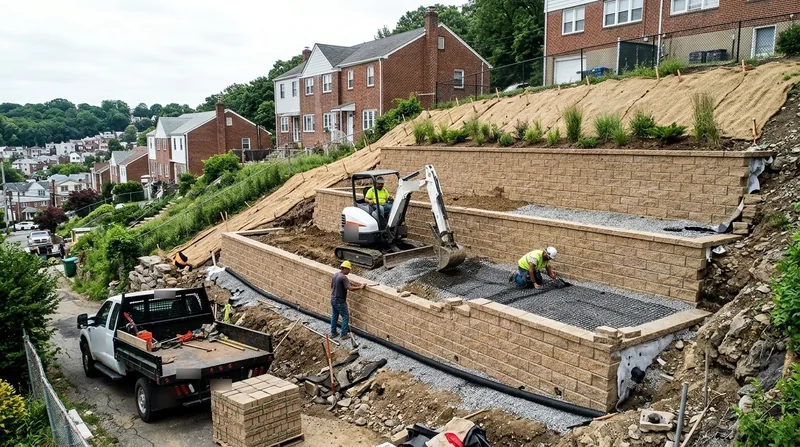




Slope stabilization and erosion control in New York City protects homes and yards on the steep, unstable slopes that define so much of the city's residential geography. From the schist ridges of Riverdale to the glacial moraine hills of Staten Island, from the cut-and-fill lots of Forest Hills to the hillside Victorians of Flatbush, New York City homeowners face serious soil movement, water runoff, and foundation risk when slopes fail. Freeze-thaw cycles crack and heave old mortared fieldstone walls. Nor'easter and hurricane downpours overwhelm clogged weep holes and underdesigned drainage. High water tables and spring snowmelt destabilize yards cut into rocky grades. We build terraced retaining walls, install geogrid reinforcement, and engineer drainage systems to stop erosion before it threatens your property. If you own a hillside lot in New York City, slope failure is not a question of if, but when and how much it will cost. The right retaining wall system, installed now, costs far less than foundation repair later.
Why Slope Stabilization Matters on New York City's Hillside Lots
New York City's residential neighborhoods sit on some of the most challenging terrain in the Northeast. Steep slopes over Manhattan schist, glacial till, and sandy outwash mean that gravity, water, and freeze-thaw stress work constantly to move soil downhill. A failing slope doesn't just damage your yard. It cracks foundations, undermines driveways, destabilizes decks, and can eventually force expensive underpinning or even abandonment of the property. The longer you wait, the more soil moves and the more expensive stabilization becomes.
- We stop soil creep and slumping by anchoring the slope with tiered retaining walls that resist hydrostatic pressure and frost heave.
- We install geogrid reinforcement to bind soil layers and increase internal shear strength on steep grades over schist and till.
- We design and install subsurface drainage systems, French drains, and weep holes to intercept groundwater before it destabilizes the slope.
- We grade and recontour hillside lots to direct surface runoff away from foundations and toward proper storm drainage.
- We tie new walls to old mortared fieldstone or collapsed timber walls, either rebuilding them or anchoring them in place to prevent further movement.
Slope stabilization on New York City's hillside lots is not cosmetic work. It is structural protection for your home and yard.
Key info: A hillside lot in Riverdale or Grymes Hill that shows signs of slope movement (tilted fences, cracks in driveways, water pooling at the base of the slope) needs professional assessment immediately. Delaying stabilization allows soil to move further and can trigger foundation damage that costs $50,000 or more to repair.
For guidance on whether your slope is stable and what permits may apply to your project, consult your local New York City or Westchester building department. Setback rules, property-line requirements, and wall height limits vary by jurisdiction and must be verified before design begins. See the leaning and collapsed wall repair page for details on emergency stabilization of walls that are already moving.
How We Stabilize Slopes and Control Erosion on New York City Hillside Properties
Slope stabilization is a three-part process: assessment, design, and installation. We begin with a site visit to understand the soil type, water table, existing walls, and slope angle. We then design a system of terraced walls, internal reinforcement, and drainage to stop the movement and protect your foundation. Finally, we build the system to code and to the specific conditions of your lot.
- We excavate the slope to remove unstable soil and expose the stable bearing layer below.
- We install a geogrid reinforcement layer, anchoring it back into the slope to increase soil cohesion and resist internal shear failure.
- We build terraced retaining walls (concrete, block, or stone) at key elevations, each wall tied to the layer below and backfilled with free-draining material.
- We install perimeter French drains, underdrains, and weep holes to intercept groundwater and channel it to daylight or to storm drainage.
- We grade and seed the slope to minimize surface runoff and allow vegetation to stabilize topsoil.
- We backfill behind the walls with clean, free-draining stone and geotextile fabric to prevent soil migration and clogging of drainage.
The result is a stable, drained slope that resists both gravity and water for decades.
Real example: A brownstone in Park Slope with a steep, eroding rear yard and a 1970s timber wall that was rotting and leaning inward. We removed the old wall, installed a three-tier segmental block system with geogrid and internal drainage, and regraded the slope with proper swales. The yard is now stable, the foundation is protected, and the homeowner has usable outdoor space. Total time: 3 weeks. See our retaining wall installation page for more examples of what we build.
Slope Stabilization & Erosion Control Methods and Materials
| Approach | Description | Best for |
|---|---|---|
| Terraced segmental block walls with geogrid | Modular concrete units stacked in tiers, each layer tied back with geogrid and internal drainage. Fast to install, flexible design, proven durability in freeze-thaw cycles. | Most hillside lots in New York City. Ideal for slopes steeper than 2:1 and for properties where appearance and long-term low maintenance matter. |
| Poured concrete retaining walls with subsurface drainage | Monolithic reinforced concrete wall, often with a battered face, tied to a reinforced footing and backed by French drain and weep holes. Handles high hydrostatic loads and integrates with old mortared stone walls. | Slopes over Manhattan schist with high water tables. Steeper grades where block alone is insufficient. Retrofit situations where the wall must tie into existing structures. |
| Boulder and natural stone retaining walls | Large natural stone or boulders, dry-stacked or mortared, often with internal geogrid and backfill drainage. Blends with existing fieldstone walls common in older neighborhoods. | Heritage properties in Park Slope, Harlem, and Riverdale where matching existing stone walls is important. Moderate slopes and lower hydrostatic loads. |
| Geogrid reinforcement with vegetated terraces and swales | Geogrid layers embedded in the slope, combined with low retaining walls, terraced planting, and swales to slow runoff and stabilize topsoil. Emphasizes drainage and vegetation over rigid walls. | Gentle to moderate slopes in residential yards. Properties where landscaping and green infrastructure are preferred. Excellent for reducing surface runoff and erosion of topsoil. |
Slope Stabilization & Erosion Control Cost in New York City: What to Expect
The cost of slope stabilization and erosion control in New York City depends on the slope size, soil type, wall height, drainage complexity, and site access. A small terraced wall system with basic drainage on a suburban lot may cost less than a multi-tier concrete and geogrid system on a steep schist slope in Riverdale or a moraine grade in Staten Island. The best way to know is to request a free estimate from a licensed contractor who can assess your specific conditions on site.
Several factors move the price up or down. A slope that is already moving or has active erosion (water running down the face, soil slumping at the toe) requires faster stabilization and may need emergency bracing, which adds cost. A lot with poor access (narrow driveway, mature trees, proximity to neighboring structures) makes equipment deployment harder and slower. A slope over bedrock or with a high water table may require more extensive drilling, dewatering, or specialized drainage design. A slope adjacent to a foundation or under a driveway carries higher liability and precision requirements. Multiple tiers of walls are more expensive than a single wall, but often necessary for steep grades. And material choice matters: segmental block is typically less expensive than poured concrete or natural stone, but may not be appropriate for all slopes or neighborhoods.
We recommend getting estimates from two or three licensed contractors. Each should visit the site, assess the soil and slope, and explain what system they recommend and why. This allows you to compare not just price, but method and confidence. Visit our pricing page for more detail on how we structure estimates and what factors move the cost for your specific job.
What to Look for When Hiring a Slope Stabilization Contractor Near Me in New York City
Slope stabilization is specialized work. You need a contractor who understands New York City geology, local building codes, and drainage design, not just someone who can dig and build a wall. Before you hire, ask the right questions and verify credentials.
License and insurance are non-negotiable. Your contractor must be licensed by the New York State Department of State or equivalent city authority to perform structural work. They must carry general liability and workers compensation insurance. Ask for a certificate of insurance and verify it with the insurance carrier. A contractor who is not licensed or insured is not worth the risk.
Get multiple estimates and ask for references. A reputable contractor will provide three or more recent references from New York City or Westchester County jobs similar to yours. Call those references and ask: Did the work stay on schedule? Did the contractor explain the work clearly? Has the wall held up? Are there any drainage or settlement issues? A contractor who has done similar work on steep slopes in your neighborhood is worth more than a low bid from someone unfamiliar with your soil type and climate.
Understand permits and setback rules for your jurisdiction. Many New York City neighborhoods and Westchester municipalities require a permit for retaining walls above 4 feet, or when the wall supports a surcharge such as a driveway or deck. Some jurisdictions require engineered drawings. Setback rules (distance from property line) vary widely. Your contractor should know your local building department's rules and should obtain the permit before work begins. If your property is in a historic district or has deed restrictions, there may be additional approvals needed. Ask your contractor to walk you through the permit process and timeline.
Ask about drainage design and how it will be maintained. A slope stabilization system is only as good as its drainage. Weep holes clog with soil and sediment over time. French drains need occasional inspection. Ask your contractor how the drainage will be designed, what maintenance is required, and whether they provide a maintenance plan or inspection schedule after the work is done.
Ready to get started? Contact us for a free, no-obligation estimate. We visit your site, assess the slope, explain the system we recommend, and give you a clear price and timeline. Call (929) 552-6465 or fill out our online form and we will respond within 24 hours.
Slope Stabilization & Erosion Control in New York City: Pricing Guide
| Service | Price | Details |
|---|---|---|
| Site assessment and design consultation | Free estimate | Includes soil analysis, slope angle measurement, drainage assessment, and recommended stabilization system with preliminary cost range |
| Small slope stabilization (terraced walls, geogrid, drainage) | Starting at $8,500 | Single or double-tier wall system on slopes under 30 feet wide, includes geogrid reinforcement, perimeter drainage, basic grading |
| Medium to large slope stabilization (multi-tier, complex drainage) | Starting at $18,000 | Three or more wall tiers, extensive geogrid, French drains, underdrains, and regrading on slopes 30 to 60 feet wide or over bedrock |
| Emergency slope stabilization or leaning wall repair | On estimate | Urgent stabilization of active slope movement or failing walls requires site visit to assess safety risk and determine temporary bracing or immediate work needed |
| Travel and project management | Included | No separate travel fee or mileage charge for jobs in New York City and surrounding Westchester and Long Island service areas |
| Free estimate response time | Free | We respond to all estimate requests within 24 hours. Call (929) 552-6465 or submit via our website, no obligation to book |
Indicative pricing, the exact cost depends on square footage, finish, and site access. Free personalized estimate within 24h at (929) 552-6465.


