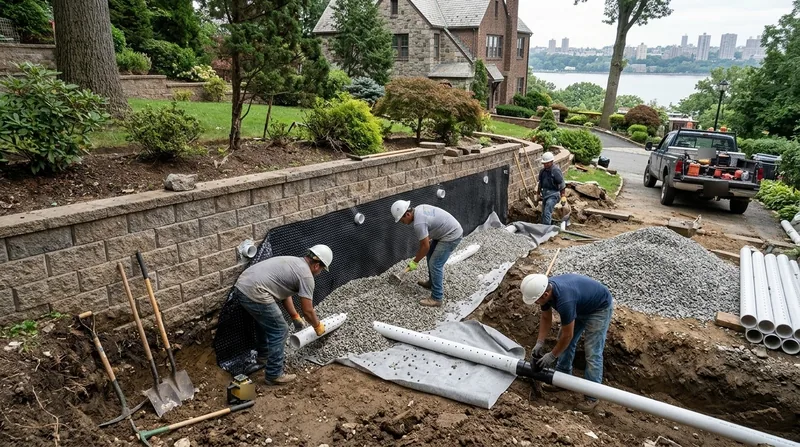




Retaining wall drainage in New York City is the difference between a wall that lasts decades and one that fails in five years. Water is the enemy of every retaining wall in this region, from the mortared fieldstone walls of Park Slope to the concrete block walls holding back yards in Forest Hills and the schist ridges of Riverdale. Freeze-thaw cycles, nor'easter downpours, and the high water tables under Staten Island's moraine soils create relentless hydrostatic pressure behind walls. Without proper drainage, that pressure builds, the wall leans, cracks, and eventually collapses. We design and install drainage systems that stop that pressure before it starts, keeping water away from the wall face and relieving it safely to daylight or storm drains.
Why Proper Retaining Wall Drainage Matters in New York City
The New York City climate and soils are brutal on retaining walls. Winter freeze-thaw cycles crack mortar and concrete. Spring snowmelt and summer thunderstorms dump water into the soil behind the wall. The clay and glacial till found across much of the city don't drain naturally, so water pools and pushes hard against the wall face. A wall without drainage doesn't just leak, it fails from the inside out, with the hydrostatic pressure doing most of the damage. Proper drainage systems intercept that water before it becomes a problem.
- We install French drains behind the wall to collect and redirect groundwater away from the structure.
- We clear and install weep holes through the wall face to let trapped water escape safely.
- We specify gravel backfill instead of compacted clay so water moves through the soil rather than pooling.
- We apply waterproof membranes to the wall face to prevent water absorption into brick, concrete, or stone.
- We tie drainage systems into existing storm drains or daylight outlets so water leaves the property entirely.
A wall with good drainage stops the number one cause of failure in this region: hydrostatic pressure from trapped water.
Key info: In New York City, most retaining wall failures happen because water collects behind the wall during winter thaw and spring rains. The New York City Building Department requires drainage plans for walls over 4 feet tall or walls that support a surcharge such as a driveway. Always check with your local building department before starting work, as setback and property-line rules vary by neighborhood and borough. See NYC Department of Buildings for permit requirements.
How We Install Retaining Wall Drainage in New York City
Our drainage work starts with an inspection of the wall, the soil behind it, and the site grading. We look for signs of water damage, efflorescence (white mineral staining), moss, or soil saturation. We identify where water is coming from, where it needs to go, and what combination of French drains, weep holes, and backfill will solve the problem. On many older walls in Harlem, Park Slope, and Flatbush, we're retrofitting drainage into walls that were built without it. On new installations, we build drainage in from the start.
- We excavate behind the wall to expose the soil and install a perforated drain pipe at the base of the footing.
- We wrap the drain pipe in landscape fabric and surround it with clean gravel so water flows into the pipe instead of pooling.
- We backfill the wall zone with coarse gravel or approved drainage stone, not clay or compacted soil.
- We drill or install weep holes through the wall face, spaced every 4 to 6 feet, so internal water has an escape route.
- We connect the drain pipe to a daylight outlet or storm drain so water exits the property and doesn't reinfiltrate nearby.
- We apply waterproof coating to the wall face if the wall is concrete, brick, or stone to reduce water absorption.
This combination of methods ensures that water never builds up behind the wall in the first place.
Example: A brownstone on Prospect Park West in Brooklyn had a 6-foot mortared fieldstone retaining wall holding back the yard. After three winters of freeze-thaw cycles and heavy spring rains, the wall was leaning outward and showing cracks in the mortar. We installed a French drain at the footing, added weep holes every 5 feet, and backfilled with drainage stone. Two years later, the wall is stable and dry. The homeowner can see daylight through the weep holes after heavy rain, which means water is leaving the wall instead of staying trapped inside.
For more on the repair process, see our page on retaining wall repair in New York City.
Drainage Methods: Choosing the Right Approach
| Approach | Description | Best for |
|---|---|---|
| French Drain | Perforated pipe at the wall footing surrounded by gravel, tied to a daylight outlet or storm drain. | Wet sites, high water tables, walls holding back clay or glacial till soils. |
| Weep Holes | 3-inch to 4-inch openings through the wall face, spaced 4 to 8 feet apart, allowing trapped water to drain to daylight. | Existing walls, retrofit work, concrete block and brick walls where internal water pressure is the issue. |
| Gravel Backfill | Clean stone, not clay or compacted soil, behind and above the wall to allow water to percolate through rather than pool. | New installations, retrofits where soil is being replaced, any wall where the existing backfill is clay or fine soil. |
| Waterproof Membrane | Liquid or sheet waterproofing applied to the wall face to reduce water absorption into concrete, brick, or stone. | Walls with porous materials, walls in high-moisture zones, concrete block walls that show efflorescence or staining. |
Most effective drainage systems use two or more of these methods together. A French drain alone won't help if water is also seeping through the wall face. Weep holes alone won't work if there's no drain pipe to collect water at the footing. We assess each wall and recommend the combination that fits the site.
Retaining Wall Drainage Cost in New York City: What to Expect
Drainage work on an existing retaining wall typically starts at $2,500 for a simple retrofit with weep holes and surface gravel backfill. Most residential drainage jobs in New York City, from Yonkers to Long Beach, run between $3,000 and $7,500 depending on the wall length, soil conditions, and whether you need a new French drain or just maintenance of existing drainage. Factors that affect cost include wall length, height, soil type, access (some yards in Forest Hills or Todt Hill are tight and require hand tools), whether you need storm drain connections or daylight outlets, and whether the existing wall is fieldstone, brick, concrete, or block.
A 30-foot wall with heavy clay behind it that needs a full French drain, new weep holes, and gravel backfill will cost more than a 20-foot wall on sandy soil that just needs weep holes and surface work. Permitting and site surveying, if required, add to the cost but are essential for walls over 4 feet or walls supporting a driveway or structure. We always provide a free estimate on site so you know exactly what the work entails before you commit. See our full pricing page for more detail on drainage and related services.
Retaining Wall Drainage Near Me: What to Look for When Hiring a Contractor in New York City
Not all contractors understand drainage systems or the specific soil and climate challenges of New York City retaining walls. Before you hire, verify that the contractor is licensed and insured for construction work in your borough or county. Ask for references from at least two drainage or retaining wall jobs completed in the past three years. Check that they understand the permit requirements for your specific location, as thresholds for walls above 4 feet and walls supporting structures vary across the city and surrounding areas. Ask whether they have experience with the wall material you have, whether it's mortared fieldstone, brick, concrete block, or poured concrete.
- Request proof of liability insurance and workers compensation coverage, and verify the policy is active.
- Get at least two or three estimates so you can compare methods, materials, and pricing.
- Ask whether the contractor has handled drainage retrofits on older walls or if they only do new installations.
- Verify that they understand the local building department permit process and can handle any required engineering or drawings.
- Call references and ask specifically about drainage performance, how the wall has held up after heavy rain, and whether the contractor was responsive to questions.
A good drainage contractor will spend time on your site, ask about your water issues, and explain exactly what they're installing and why. If someone gives you a price over the phone without seeing the wall, keep looking.
Ready to get started? Contact us for a free estimate at (929) 552-6465. We'll inspect your wall, identify the drainage problem, and tell you what it will cost to fix it. No obligation, response within 24 hours.
Retaining Wall Drainage in New York City: Pricing Guide
| Service | Price | Details |
|---|---|---|
| Drainage retrofit (weep holes and surface work) | Starting at $2,500 | Cleaning and installing weep holes, surface gravel backfill, and minor waterproofing on existing walls up to 30 feet long |
| French drain installation (new or replacement) | Starting at $4,000 | Excavation, perforated pipe, gravel wrap, and connection to daylight outlet or storm drain for walls 25 to 40 feet long |
| Full drainage system (French drain plus weep holes and backfill) | Starting at $5,500 | Complete drainage design and installation combining subsurface drainage, wall face weep holes, and approved backfill material |
| Complex or large-scale drainage work | On estimate | Walls over 40 feet, high water tables, tiered walls, or sites requiring engineering drawings and multiple drainage zones need site inspection |
| Travel and site visit | Included | No separate charge for travel within New York City and surrounding service areas covered by our team |
| Free estimate | Free | Site inspection, drainage assessment, and written estimate with no obligation to book, response within 24 hours |
Indicative pricing, the exact cost depends on square footage, finish, and site access. Free personalized estimate within 24h at (929) 552-6465.


