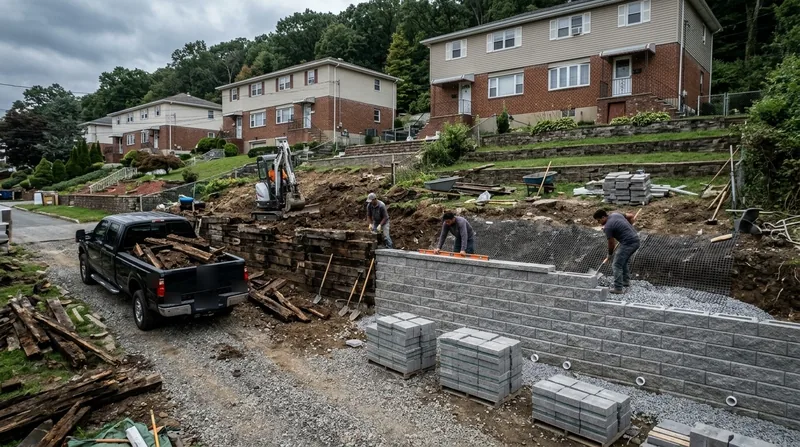




Aging retaining walls are a defining feature of New York City residential life. From the mortared fieldstone schist rubble holding back yards in Riverdale to the rotting railroad ties and timber walls cut into the slopes of Todt Hill and Staten Island's moraine, retaining wall replacement in New York City is often the only lasting solution when freeze-thaw cycles, frost heave, clogged drainage, and nor'easter downpours have done their work. Whether your wall is a 1970s-era timber structure leaning visibly inward, a brick or CMU wall showing active seepage, or a poured concrete wall with horizontal cracks and bowing, we remove the failed structure completely, haul away the debris, install modern drainage, and build a new wall engineered to handle New York City's harsh winters and wet springs. This is not a repair. This is a full rebuild.
Why Retaining Wall Replacement Matters in New York City's Aging Housing Stock
New York City's residential neighborhoods were built over decades, and the walls that hold them together show their age. A wall that has stood for 40 or 50 years under Manhattan schist bedrock and glacial till, exposed to repeated freeze-thaw cycles and heavy downpours, reaches a point where patching and pointing no longer work. The structural integrity fails, drainage clogs, and the wall begins to lean, crack, or collapse. Replacement is the only safe and permanent option.
- We remove the entire failed wall structure, including all rotting timber, crumbling brick, or deteriorated concrete.
- We excavate and properly grade the site to ensure water drains away from the footing and does not pool behind the new wall.
- We install new engineered materials, whether segmental block, poured concrete, or natural stone, with full drainage infrastructure including weep holes and a gravel or perforated pipe system.
- We obtain all required permits from the local building department and follow setback and property-line rules specific to your jurisdiction.
- We haul away all debris and leave the site clean and ready to use.
A properly installed replacement wall protects your property, prevents flooding and erosion, and adds decades of service life.
Key info: In New York City, walls above roughly 4 feet measured from the footing, or walls supporting a driveway or structure, typically require a permit. Engineered drawings are mandatory for tall or tiered walls. Always verify current thresholds with your local building department before planning work. The rules vary by borough and neighborhood.
For more on the full scope of wall work, see our guide to retaining wall repair in New York City.
How We Execute a Full Retaining Wall Replacement in New York City
A successful replacement job requires careful sequencing, proper site assessment, and attention to drainage. We start with a detailed site visit to understand soil conditions, water movement, and any constraints imposed by neighboring properties or underground utilities. We then plan the demolition, drainage, and rebuild in phases to minimize disruption and ensure the new wall is built to last.
- We conduct a free site inspection and measure the wall, assess soil and drainage conditions, and identify any utilities or property-line issues.
- We obtain or assist with permitting, providing engineered drawings if required by your local building department.
- We demolish the old wall, break up and remove all concrete or masonry, and haul away the debris off-site.
- We excavate and prepare the footing to proper depth and grade, ensuring the site is ready for a new foundation.
- We install new drainage infrastructure, including gravel backfill, perforated pipe, or weep holes, depending on site conditions and the new wall material.
- We build the new wall using engineered materials and techniques appropriate to the site and approved by the building department.
- We grade and finish the site, restore landscaping if needed, and perform a final walkthrough with you.
The entire process, from permit to final grade, typically takes 2 to 4 weeks for a standard residential wall, depending on size, site access, and weather.
Example: A Park Slope brownstone with a 12-foot mortared fieldstone wall showing active seepage and horizontal cracks required a full tear-out and replacement with engineered segmental block, new drainage, and proper setback from the property line. The job took 3 weeks from permit approval to final grading, and the new wall has performed flawlessly through two winters since completion.
Learn more about our retaining wall drainage solutions to understand how proper water management protects your new wall.
Retaining Wall Replacement Methods and Materials for New York City Sites
The right material for your replacement wall depends on site conditions, budget, aesthetic preference, and the specific soil and drainage challenges of your lot. New York City sites range from flat sandy outwash in southern Brooklyn and Queens to steep, rocky grades over Manhattan schist and glacial till. We offer multiple proven approaches, each with its own strengths.
| Material | Description | Best For |
|---|---|---|
| Segmental Block (SRW) | Interlocking concrete units stacked and set back at a slight angle, with soil reinforcement and drainage behind. | Steep slopes, high loads, modern appearance, and fast installation. Durable in freeze-thaw climates. |
| Poured Concrete | Monolithic reinforced concrete wall, formed and cast on-site or precast and set in place. | Tall walls, high surcharges (driveways, structures), and sites where a smooth finish is desired. |
| Natural Stone and Boulder | Mortared or dry-stacked fieldstone, schist, or large boulders, often matching the character of older New York City walls. | Historic neighborhoods, aesthetic continuity, and sites where durability and charm are priorities. |
| Timber or Composite | Pressure-treated lumber or composite materials, typically for lower walls or aesthetic applications. | Shorter retaining walls under 4 feet, informal landscaping, and sites where wood appearance suits the design. |
We assess your site, discuss your budget and preferences, and recommend the material that offers the best balance of durability, cost, and appearance for your New York City property.
Retaining Wall Replacement Cost in New York City: What to Expect
The cost of a full retaining wall replacement in New York City depends on several factors: the size and height of the wall, the material chosen, site access and terrain, drainage complexity, permitting requirements, and whether the footing must be cut into bedrock or glacial till. Most residential replacement jobs in the New York City area start at $35 per square foot for segmental block or poured concrete, with natural stone and engineered solutions often running higher. A 30-foot-long wall standing 8 feet tall, for example, would be roughly 240 square feet and could range from $8,400 to $15,000 or more, depending on material, drainage, and site conditions.
Several factors drive the cost up or down. Difficult site access, steep grades requiring extensive excavation, rocky soil that demands blasting or heavy equipment, and complex drainage all increase the price. A wall that must support a surcharge, such as a driveway or deck, requires engineered design and reinforcement, adding cost. Permitting and engineer's fees, if required, are additional. Conversely, a straightforward replacement on a flat, accessible lot with good drainage and no surcharge will be closer to the base rate.
We recommend getting 2 to 3 estimates before deciding. Each contractor will assess the site differently and may propose different materials or methods. A detailed written estimate should break down labor, materials, drainage, permitting, and any contingencies. Visit our pricing page for a more detailed breakdown and to understand what moves the needle on your specific job.
Retaining Wall Replacement Near Me: What New York City Homeowners Should Know When Hiring a Contractor
Choosing the right contractor for a retaining wall replacement is one of the most important decisions you will make. A poorly built wall will fail again within a few years, wasting money and putting your property at risk. A well-built wall will last 30, 40, or 50 years with minimal maintenance. Here is what to look for when comparing contractors near New York City.
Verify licensing and insurance. A legitimate retaining wall contractor in New York City must carry a valid general contractor's license (or appropriate trade license) issued by the state, and proof of liability and workers' compensation insurance. Ask to see certificates before work begins. This protects you if an accident occurs or if the work is defective.
Get multiple written estimates. Never hire based on a phone quote alone. Each contractor should visit your site, assess the conditions, and provide a detailed written estimate that lists materials, labor, drainage, permitting, timeline, and any contingencies. Compare apples to apples: if one estimate is much lower than the others, ask why. Often it means corners are being cut on drainage, soil preparation, or engineering.
Check references and past work. Ask for photos of completed jobs in your neighborhood (Flatbush, Forest Hills, Riverdale, Staten Island) and speak to previous clients. A contractor with a strong local reputation and a portfolio of long-standing walls is a safer bet than one with no track record.
Understand permits and regulations. Your contractor should be able to explain whether your wall requires a permit, what the local building department's rules are, whether engineered drawings are needed, and what setback and property-line rules apply. If your wall is in a historic district or an area with HOA rules, your contractor should know how to navigate those. If they seem uncertain, that is a red flag.
Ask about drainage and long-term durability. The difference between a wall that lasts 50 years and one that fails in 10 is drainage. A good contractor will explain their drainage strategy, including how water will be managed behind and below the wall. Clogged or missing drainage is the number-one reason walls fail in New York City's wet climate.
Ready to get started? Contact us for a free, no-obligation estimate. We will assess your wall, discuss your options, and provide a detailed written quote within 24 hours.
Retaining Wall Replacement in New York City: Pricing Guide
| Service | Price | Details |
|---|---|---|
| Segmental Block Replacement | Starting at $35/sq ft | Standard interlocking block wall with drainage, labor, and material. Increases with height, slope steepness, and site access difficulty. |
| Poured Concrete Replacement | Starting at $40/sq ft | Reinforced monolithic concrete with formwork, curing, and drainage. Rises with wall height, reinforcement complexity, and surcharge requirements. |
| Natural Stone or Boulder Replacement | Starting at $45/sq ft | Mortared or dry-stacked fieldstone, schist, or boulders. Premium pricing reflects material cost, sourcing, and skilled masonry labor. |
| Complex or Large-Scale Job | On estimate | Tiered walls, extensive excavation, bedrock cutting, or engineered designs require site assessment and detailed proposal before pricing. |
| Travel and Permitting | Included | No separate mileage fee within New York City and surrounding areas. Permit assistance and drawing costs quoted separately as needed. |
| Free Site Estimate | Free | Detailed on-site inspection, material recommendations, and written quote provided at no cost within 24 hours of request. |
Indicative pricing, the exact cost depends on square footage, finish, and site access. Free personalized estimate within 24h at (929) 552-6465.


