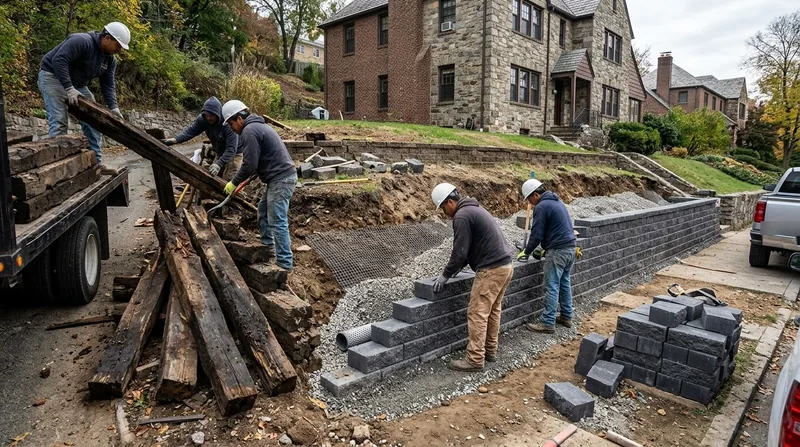




Railroad Tie Wall Replacement in New York City is one of the most common retaining wall jobs we handle, especially across Brooklyn, Queens, and Staten Island neighborhoods where 1970s and 80s timber construction dominates residential lots. These creosote-treated railroad tie walls fail predictably under New York City's freeze-thaw cycles, nor'easter rainfall, and the glacial till and schist terrain that creates steep, water-saturated slopes throughout the city. Whether your wall is leaning, crumbling, or actively collapsing, we remove the rotting timber, haul away the debris, rebuild with modern materials, and install proper drainage to prevent future failure. This guide covers why railroad tie walls fail in New York City, how we replace them, realistic costs, and what to look for when hiring a contractor. Call us at (929) 552-6465 for a free estimate, or visit our Retaining Wall Replacement page for the full scope of our work.
Why Railroad Tie Walls Fail in New York City: The Freeze-Thaw and Drainage Problem
Railroad tie walls built in the 1970s and 1980s across New York City were designed to last 20 to 30 years, and most have now exceeded that lifespan by a decade or more. The creosote treatment was meant to resist rot, but freeze-thaw cycles in New York City winters, especially after heavy nor'easter rains, force water into the wood, expand it, crack it, and then freeze it solid. Over time, the ties split, the soil behind them shifts, and the wall leans or collapses entirely. Clogged weep holes and poor backfill drainage compound the problem, trapping water and accelerating failure.
- We inspect for water saturation, frost heave, and soil pressure behind the wall.
- We check for timber decay in the tie face, which signals imminent structural failure.
- We assess leaning or bulging, which indicates the wall is losing its ability to hold soil.
- We evaluate drainage failure, including clogged weep holes and missing backfill gravel.
Any one of these conditions is reason to replace the wall before it fails catastrophically and damages adjacent property or threatens safety.
Key info: In Park Slope, Flatbush, Forest Hills, and Riverdale, we routinely find railroad tie walls that have been saturated by decades of groundwater and seasonal snowmelt. The schist ridges and glacial till in these neighborhoods create naturally poor drainage, which accelerates timber failure. If your wall is over 40 years old and shows any signs of lean, seepage, or wood rot, replacement should be your priority.
For more detail on common wall failures across New York City, see our Leaning and Collapsed Wall Repair page.
How We Replace Railroad Tie Walls: A Step-by-Step Process in New York City
Replacing a railroad tie wall is not a simple removal and rebuild. We must safely excavate the old wall, haul away creosote-treated timber (which is hazardous waste in New York City), stabilize the slope, install proper drainage, and construct a new wall that meets current codes and will last 50 years or more. Each job is custom, and the process depends on the wall height, soil type, and what we're rebuilding with.
- We obtain permits from the local building department if the wall exceeds height thresholds or supports a surcharge such as a driveway or structure.
- We excavate and remove the old railroad ties, cut them into manageable lengths, and haul them to a licensed waste facility for proper disposal.
- We regrade the slope and compact the soil to remove voids and ensure stable bearing for the new wall.
- We install drainage behind the new wall, including perforated pipe, gravel backfill, and weep holes spaced every 4 to 6 feet.
- We build the new wall in segmental block, poured concrete, or natural stone, depending on your property and budget.
- We finish and grade the area, restore landscaping, and verify proper drainage before we leave the site.
The entire process typically takes 1 to 3 weeks, depending on wall length and complexity.
Example: A 30-foot timber wall in Todt Hill, Staten Island, required removal of 180 linear feet of rotting ties, excavation of 60 cubic yards of saturated soil, installation of new perforated drainage pipe, and a rebuild in segmental block. Total time: 12 working days. The new wall has a 50-year warranty and proper gravel backfill, eliminating the water saturation that destroyed the original.
Learn more about our Retaining Wall Drainage solutions to ensure your new wall stays dry and stable.
Replacement Methods and Materials: Choosing What Works for Your New York City Property
Once we remove the old railroad tie wall, you have several options for the new structure. Each material offers different aesthetics, durability, and cost. We help you choose based on your budget, the slope angle, soil type, and the look you want.
| Approach | Description | Best for |
|---|---|---|
| Segmental Block (SRW) | Interlocking concrete blocks stacked without mortar, backfilled with gravel and geotextile. Allows slight movement and excellent drainage. 50-year lifespan. | Most common choice in New York City. Fast installation, clean lines, minimal maintenance. Works on slopes up to 45 degrees. |
| Poured Concrete | Monolithic concrete wall cast on-site or precast panels. Requires footer below frost line (typically 48 inches in New York City). Very strong, long lifespan (60+ years). | Tall walls, high soil pressure, or where a smooth, finished look is required. More expensive and requires careful drainage design. |
| Boulder and Natural Stone | Large fieldstone, schist, or granite boulders stacked with smaller fill stone and gravel. Fits the historic character of older New York City neighborhoods. Excellent drainage. | Properties in Riverdale, Park Slope, and Harlem where stone walls match the existing streetscape. Shorter walls (under 4 feet) or decorative purposes. |
| Timber (Pressure-Treated or Composite) | New pressure-treated lumber or composite materials. Treated lumber lasts 20 to 30 years in New York City climate. Composite alternatives last longer but cost more. | Short-term solution or aesthetic preference. Not recommended for slopes with poor drainage or high water tables, given the freeze-thaw environment of New York City. |
Railroad Tie Wall Replacement Cost in New York City: What to Expect
Most railroad tie wall replacement projects in New York City start at $35 per square foot for a segmental block rebuild, including demolition, haul-away, new drainage, and installation. A 30-foot wall that is 4 feet tall (120 square feet) typically costs between $4,200 and $6,000, depending on soil conditions, access, and whether we need to bring in heavy equipment or work around underground utilities.
Several factors move the cost up or down. If the slope is steep or the soil is saturated, we may need additional drainage work or soil stabilization, adding $500 to $2,000. If the site has limited access (narrow driveways, steep grades, or dense trees), we may need to hand-haul materials, which increases labor time. Poured concrete is typically 20 to 30 percent more expensive than segmental block. Natural stone is highly variable, depending on the stone source and the size of boulders. For a detailed pricing breakdown, visit our full pricing page.
We always recommend getting 2 to 3 estimates before you decide. Make sure each contractor includes demolition, haul-away, drainage, and a warranty. Some contractors quote removal only and charge extra for the rebuild, so read the fine print. We include all of it in one transparent price.
Railroad Tie Wall Replacement Near Me: What New York City Homeowners Should Know When Hiring
Hiring the right contractor for your railroad tie wall replacement is as important as choosing the material. You want someone who understands New York City building codes, has experience with the specific soil and terrain in your neighborhood, and can navigate the permit process without delay. Here is what to look for when you call around.
- Confirm the contractor is licensed and insured in New York City, with current general liability and workers' compensation coverage.
- Ask whether they have experience with permits in your local building department and whether they handle the application or leave it to you.
- Request references from recent jobs in your neighborhood (Park Slope, Flatbush, Forest Hills, Riverdale, or Todt Hill, for example).
- Verify they haul away creosote-treated timber to a licensed waste facility, not a general dumpster.
- Check whether they offer a warranty on the new wall structure and on drainage performance.
- Ask about timeline and scheduling, especially if you need the wall done before winter or before a major weather event.
If your property is in a historic district or falls under an HOA, ask whether the contractor has worked within those restrictions. Some neighborhoods require historic-matching materials or design approval from the city landmarks commission. A good contractor will know this and factor it into the estimate.
Ready to get started? Contact us for a free, no-obligation estimate. We respond within 24 hours and can often schedule a site visit the same week.
Railroad Tie Wall Replacement in New York City: Pricing Guide
| Service | Price | Details |
|---|---|---|
| Segmental Block Wall Replacement | Starting at $35/sq ft | Includes demolition, haul-away, gravel backfill, drainage, and new block installation; cost varies with wall height and soil conditions |
| Poured Concrete Wall Replacement | Starting at $45/sq ft | Includes frost-line footing, concrete pour or panel installation, drainage design, and finishing; higher cost reflects structural strength and longevity |
| Natural Stone or Boulder Wall Replacement | Starting at $50/sq ft | Includes stone sourcing, stacking, gravel backfill, and drainage; final price depends on stone availability and wall height in your New York City neighborhood |
| Complex or multi-tiered walls, steep slopes, or poor access | On estimate | Requires site visit to assess soil stability, drainage challenges, equipment access, and whether additional slope stabilization or geotextile reinforcement is needed |
| Travel and site visit | Included | No separate mileage or travel fee within New York City and surrounding service areas; estimate is free and binding for 30 days |
Indicative pricing, the exact cost depends on square footage, finish, and site access. Free personalized estimate within 24h at (929) 552-6465.


