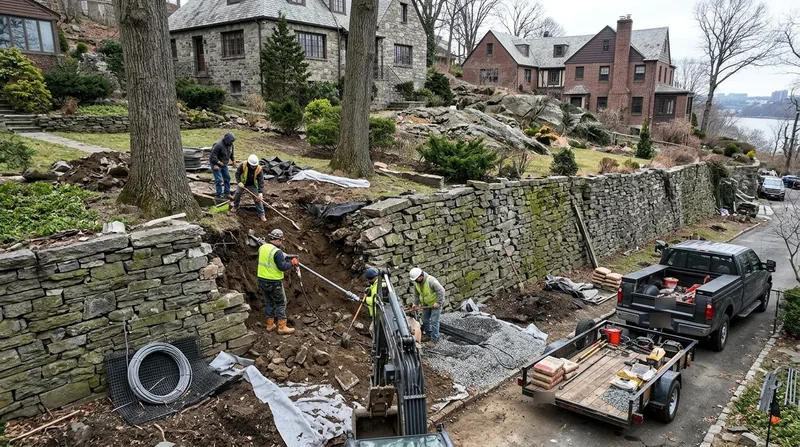




Retaining Wall Repair in New York City is not a cosmetic fix. Across Park Slope brownstones, Riverdale hillside homes, and Staten Island's glacial slopes, walls built from mortared fieldstone, brick, and aging timber fail under freeze-thaw cycles, clogged drainage, and nor'easter downpours. When a wall leans, bows, cracks, or heaves, the cost of delay is structural failure, property damage, and safety risk. We stop that failure before collapse happens, using targeted drainage correction, tieback anchors, and partial rebuilds that restore stability without unnecessary full replacement. If you see standing water at the base, horizontal cracks, or soil bulging behind the wall, call now.
Why Retaining Wall Repair Matters in New York City's Challenging Terrain
New York City's geology is unforgiving. Manhattan schist, glacial till, and sandy outwash create steep, unstable grades. Winter freeze-thaw cycles crack mortar and ice-wedge stone. Nor'easters and hurricane-driven rain overwhelm weep holes and drainage systems. Old fieldstone and brick walls, common in Harlem, Flatbush, and Forest Hills, were built without modern drainage or engineering. Timber and railroad tie walls from the 1970s and 1980s rot from below. When drainage fails or frost heave lifts the footing, the wall moves. Repair now stops the damage cycle and protects your foundation, driveway, and property line.
- We identify the root cause: clogged weep holes, poor drainage, frost heave, or inadequate tieback anchors.
- We install or replace drainage systems to divert water away from the wall footing and backfill.
- We install tieback anchors or soil nails to restabilize leaning or bowing walls without full demolition.
- We perform targeted mortar repointing and crack sealing on stone and brick walls to stop water infiltration.
- We rebuild sections of failed timber or railroad tie walls with engineered block or stone where necessary.
Early repair saves money and prevents collapse that can damage neighboring properties or create liability.
Key info: Freeze-thaw damage accelerates every winter in New York City. A wall that bows 2 inches in January may fail completely by March if drainage is not corrected. Homeowners in Riverdale, Todt Hill, and Grymes Hill experience the most aggressive frost heave because of the schist bedrock and glacial soils. Repair during fall or early spring, before ground saturation peaks.
How We Repair Retaining Walls Across New York City's Neighborhoods
Our process begins with a site inspection and diagnosis. We photograph the wall, check drainage, probe for rot and mortar failure, and assess soil conditions. For walls over 4 feet or supporting a driveway or structure, we coordinate with your local building department to confirm permit requirements. We then outline the repair scope, cost, and timeline before any work starts. Depending on the wall material, condition, and failure mode, we choose the most cost-effective repair method.
- We inspect the wall, document damage, and test drainage and footing stability on site.
- We verify permit thresholds with your local New York City or county building department.
- We mobilize equipment and materials, and prepare the work area for safety and access.
- We execute drainage correction, anchor installation, repointing, or partial rebuild as planned.
- We backfill, compact, and grade the site, and provide a written warranty on our work.
Total repair time ranges from 2 to 10 days, depending on wall length, material, and scope. We keep disruption minimal and clean the site daily.
Example: A Park Slope brownstone had a 12-foot mortared fieldstone wall leaning 3 inches into the yard. Weep holes were blocked by soil and debris. We cleaned the weep holes, installed a perforated drain pipe behind the wall, and installed three tieback anchors into the stable soil beyond the property line. The wall stopped moving within 48 hours. Cost was $4,200, and the repair took 4 days. Full replacement would have cost $18,000 and required temporary bracing of the brownstone foundation.
Retaining Wall Repair Methods and Materials
| Repair Method | Description | Best For |
|---|---|---|
| Drainage Correction and Weep Hole Cleaning | Clear blocked weep holes, install perforated drain pipe, and grade backfill to shed water away from the wall footing. | Stone, brick, and block walls with water accumulation, seepage, or minor bowing caused by hydrostatic pressure. |
| Tieback Anchors and Soil Nails | Install stainless steel anchors or nails into stable soil beyond the wall, tensioned to pull the wall back to plumb and prevent further movement. | Leaning or bowing walls in schist or till soils where the footing is stable but the wall face has moved outward. |
| Mortar Repointing and Crack Sealing | Remove failed mortar, repoint joints with lime or Portland-based mortar, and seal horizontal cracks with flexible sealant to stop water entry. | Fieldstone, brick, and rubble walls with mortar loss, cracking, or frost spall damage common in Harlem and Park Slope brownstones. |
| Partial Rebuild or Section Replacement | Remove the failed section of the wall, rebuild with new engineered block, stone, or timber, and tie the new section into the stable portions. | Rotted timber or railroad tie walls, severely cracked or heaved sections, or walls with undermined footings or soil loss. |
| Footing Stabilization and Underpinning | Excavate and inspect the footing, remove soft or displaced soil, install a compacted gravel or concrete base, and reset the wall on a stable bearing surface. | Walls with frost heave, settlement, or soil loss beneath the footing, particularly on slopes cut through glacial till or schist. |
Retaining Wall Repair Cost in New York City: What to Expect
Retaining wall repair costs in New York City range from $1,500 for drainage correction and weep hole cleaning to $12,000 or more for major anchor installation or partial rebuilds. The primary cost drivers are wall material, length, height, and failure mode. A 20-foot stone wall with clogged drainage costs less to repair than a 40-foot leaning wall requiring multiple tieback anchors. Access difficulty, proximity to structures, and soil conditions also affect pricing. A wall on a steep Riverdale slope with limited equipment access costs more than a wall in a level Forest Hills yard. We provide a detailed written estimate after a site visit, and we encourage homeowners to request 2 or 3 estimates before deciding.
For detailed pricing on common repair scenarios, visit our pricing page. Emergency or expedited repairs may incur additional fees. All estimates are free and valid for 30 days.
Retaining Wall Repair Near Me: What to Look for When Hiring a Contractor in New York City
Not every contractor understands the specific geology and climate challenges of New York City. When hiring a retaining wall repair contractor, verify three things: licensing and insurance, local experience, and permit knowledge. Ask for references from recent jobs in your neighborhood, Park Slope, Riverdale, or Staten Island. Request proof of New York State contractor licensing and general liability insurance. Understand whether your wall requires a permit by contacting your local building department, because thresholds vary by borough and wall height. If your wall supports a driveway, deck, or structure, or exceeds 4 feet measured from the footing, a permit is likely required. Some walls may also fall under historic preservation rules if in a landmark district.
- Ask for three references from similar repair jobs completed in the past 18 months in New York City.
- Confirm whether your wall requires a permit by contacting your local building department before work starts.
- Request a detailed written estimate that itemizes materials, labor, drainage work, and any permit or engineering costs.
- Check whether your HOA or historic district board has approval requirements for wall repair or drainage modification.
Get everything in writing, including warranty terms and a completion date. If a contractor pressures you to start work without a permit or estimate, walk away. Contact us for a free estimate at (929) 552-6465 or through our contact page. We handle all permit coordination and provide a 5-year warranty on repair work.
Retaining Wall Repair in New York City: Pricing Guide
| Service | Price | Details |
|---|---|---|
| Drainage Correction and Weep Hole Cleaning | Starting at $1,500 | Includes cleaning blocked weep holes, installing perforated drain pipe, and grading backfill. Cost varies by wall length and soil compaction difficulty. |
| Tieback Anchor Installation (per anchor) | Starting at $800 | Stainless steel anchor drilling, tensioning, and finishing. Multiple anchors often needed for leaning walls; total cost depends on wall length and soil conditions. |
| Mortar Repointing and Crack Sealing | Starting at $2,200 | Includes mortar removal, repointing of joints, and flexible crack sealant. Cost scales with wall area, stone type, and mortar joint condition. |
| Partial Rebuild or Section Replacement | Starting at $5,000 | Labor and materials for demolition, foundation prep, and rebuild of failed wall sections. Requires site visit to confirm scope and material choices. |
| Footing Stabilization and Underpinning | On estimate | Excavation depth, soil bearing capacity, and compaction labor vary widely. Must be assessed on site before pricing. |
| Free Estimate and Permit Coordination | No charge | 24-hour response time, site inspection, written estimate, and full building department permit guidance included with no obligation to book. |
Indicative pricing, the exact cost depends on square footage, finish, and site access. Free personalized estimate within 24h at (929) 552-6465.


