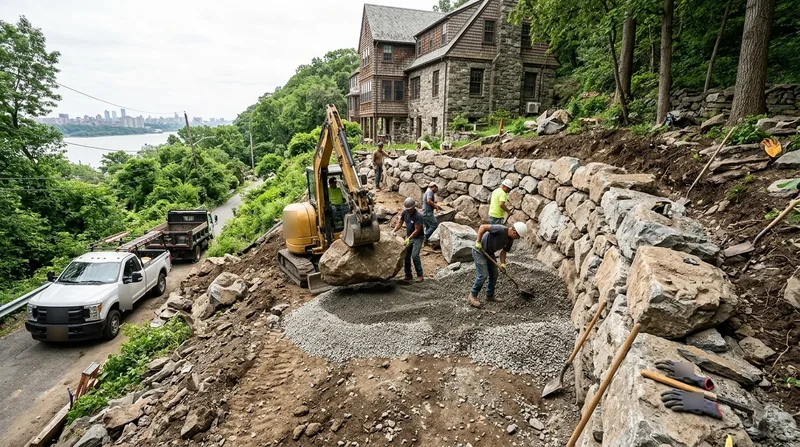




Boulder and natural stone retaining walls are a signature choice for New York City homeowners with rocky, sloped lots, especially across the schist ridges of Riverdale, the glacial till grades of Todt Hill and Grymes Hill in Staten Island, and the steep terrain carved into Brooklyn's Prospect Heights and Park Slope neighborhoods. These walls blend seamlessly into yards where bedrock and fieldstone already dominate the landscape, offering both durability and visual continuity with the surrounding geology. Unlike uniform concrete or block walls, natural stone and boulder construction respects the character of New York City's varied residential terrain, from Victorian-era brownstones perched on Manhattan schist to modern homes cut into moraine slopes. Freeze-thaw cycles, nor'easter downpours, and high seasonal water tables demand walls built with proper base preparation, drainage, and stone selection that can weather decades of Northeast winters. We install, repair, and replace boulder and natural stone retaining walls across New York City and the surrounding areas, using machine-placed rock construction and field-proven methods tailored to your lot's specific grade and drainage challenges. Whether you need a new wall to stabilize a hillside yard, repair a leaning fieldstone structure, or replace a failed timber wall with durable stone, we handle the entire process from site assessment through final grading.
Why Boulder and Natural Stone Retaining Walls Matter in New York City Hillside Yards
New York City's residential landscape is defined by dramatic terrain variation. Lots in Riverdale, Forest Hills, Flatbush, and Staten Island's South Shore sit on steep grades where gravity, water infiltration, and seasonal freeze-thaw cycles work constantly to destabilize soil and existing walls. Fieldstone and mortared schist rubble walls from the early 1900s fail from frost heave and clogged weep holes. Timber and railroad tie walls installed in the 1970s and 80s rot and collapse under winter moisture and summer sun exposure. A properly constructed boulder and natural stone wall resists these failure modes through mass, proper drainage, and the inherent durability of stone in a freeze-thaw climate.
- Boulder walls distribute weight evenly and resist frost heave better than mortared rubble or timber structures.
- Natural stone drains water naturally through gaps between stones, reducing the hydrostatic pressure that collapses concrete and block walls.
- Machine-placed stone construction creates a stable, compacted base that handles seasonal ground movement and heavy nor'easter rainfall.
- Visual integration with existing bedrock and fieldstone adds property value and blends with New York City's natural geography.
These walls are the long-term solution for homeowners tired of replacing failed timber or repairing leaning concrete structures every 10 to 15 years.
Key info: Many New York City lots in Riverdale, Todt Hill, and Park Slope sit on steep grades over Manhattan schist and glacial till, where freeze-thaw cycles and nor'easter downpours are the dominant failure modes for walls. Natural stone and boulder construction is the regional standard for hillside properties where durability and visual continuity matter most.
For more information on wall failure modes and repair priorities, see our guide to leaning and collapsed wall repair in New York City.
How We Build Boulder and Natural Stone Retaining Walls in New York City: Step-by-Step Process
Our process starts with a detailed site assessment of your lot's drainage, soil composition, grade, and any existing wall or foundation proximity. We identify the frost line depth (typically 36 to 42 inches in New York City), verify setback and property-line rules with your local building department, and determine whether an engineered drawing is required for your wall height and surcharge (such as a driveway or structure load). Once the scope is clear, we excavate and prepare a compacted gravel base, set the first course of stone, and build upward with proper backfill and drainage stone behind the wall face.
- We conduct a free site visit and assess soil, drainage, grade, and any existing wall condition or damage.
- We verify local permit requirements with the building department and prepare engineered drawings if your wall exceeds roughly 4 feet or supports a surcharge.
- We excavate to the frost line, compact the base with gravel, and install perimeter drainage stone to manage seasonal water flow.
- We machine-place and hand-set each stone course, checking level and face alignment as the wall rises.
- We backfill behind the wall with compacted stone and soil, install weep holes or drainage fabric as needed, and finish grading around the wall.
This methodical approach ensures your wall handles New York City's freeze-thaw cycles, heavy rain events, and long-term ground settlement without tilting or failing.
Local example: A Park Slope homeowner with a 30-foot-long leaning fieldstone wall and a driveway surcharge needed an engineered design and a permit from the NYC Department of Buildings. We built a new 5-foot boulder wall with a compacted base, proper drainage, and a 2-foot setback from the property line. The wall was completed in 3 weeks and has held solid through two winters of heavy snow and spring thaw.
For details on drainage and water management around your wall, see retaining wall drainage solutions.
Boulder and Natural Stone Wall Methods and Materials
| Approach | Description | Best for |
|---|---|---|
| Machine-placed boulder wall | Large stones (12 to 24 inches and up) set with an excavator, hand-fit and compacted. Minimal mortar or dry-stacked. | Hillside lots in Riverdale, Todt Hill, Staten Island. High visual impact, excellent drainage, minimal maintenance. |
| Dry-stacked fieldstone wall | Reclaimed or quarried fieldstone laid without mortar, relying on weight and fit. Natural, rustic appearance. | Historic properties, Park Slope brownstones, Forest Hills Victorians. Blends with existing 1800s and early 1900s walls. |
| Mortared schist or granite wall | Quarried stone or local schist set in lime-based mortar. Higher structural rating, allows taller walls with surcharge. | Engineered walls, driveway surcharge, tall slopes. Requires proper curing and drainage to avoid freeze-thaw damage. |
| Hybrid boulder and stone wall | Combination of large boulders and smaller stone fill, compacted and drained. Maximizes stability and visual variety. | Mixed-terrain lots, tiered walls, steep grades. Adapts to uneven bedrock and existing foundation proximity. |
Boulder and Natural Stone Retaining Walls Cost in New York City: What to Expect
Boulder and natural stone retaining wall pricing in New York City typically starts at $25 per square foot of wall face, depending on stone type, wall height, site access, and drainage complexity. A 30-foot-long wall standing 4 feet tall (120 square feet) might run $3,000 to $4,500 for a straightforward machine-placed boulder installation. Taller walls, engineered designs, difficult access, or premium stone selections can push costs higher. Frost line depth, existing soil and bedrock conditions, and the need for extensive grading or drainage work all affect the final price.
The most cost-effective approach is to get 2 to 3 on-site estimates from licensed contractors who can assess your lot's specific challenges and provide a detailed scope. A free estimate includes a site visit, measurement, soil and drainage assessment, and a clear price range with itemized labor and materials. Travel and initial consultation are included across New York City and surrounding areas, with no separate mileage fee.
For a full breakdown of pricing and financing options, visit our pricing page.
Boulder and Natural Stone Walls Near Me: What to Look for When Hiring a Retaining Wall Contractor in New York City
Hiring the right contractor for a boulder or natural stone wall is as important as the design itself. Ask for references from similar jobs in your neighborhood (Riverdale, Todt Hill, Forest Hills, Park Slope, etc.) and verify that the contractor has experience with engineered walls, permit applications, and freeze-thaw drainage in the Northeast. Understanding local setback rules, property line regulations, and building department thresholds for your specific jurisdiction is non-negotiable.
Before you sign a contract, confirm that the contractor will obtain or help you obtain any required permits, provide a written scope of work with a start and completion date, and explain how drainage and base preparation will be handled on your specific lot. If your property is subject to an HOA or historic district rules, ask how the contractor will coordinate with those requirements. Many New York City neighborhoods have design guidelines or heritage considerations that affect wall materials and height.
Contact us today for a free estimate and consultation. We respond within 24 hours at (929) 552-6465, and we handle all permitting and design coordination for you.
Boulder & Natural Stone Walls in New York City: Pricing Guide
| Service | Price | Details |
|---|---|---|
| Machine-placed boulder wall | From $25/sq ft | Standard installation with compacted base and drainage, includes site assessment and grading, varies by stone size and access |
| Dry-stacked fieldstone wall | From $28/sq ft | Reclaimed or quarried fieldstone, hand-fit without mortar, higher labor cost for fit and finish quality |
| Engineered mortared stone wall | From $35/sq ft | Structural design, permit drawings, lime-based mortar, taller walls with surcharge, includes engineer consultation |
| Repair or replacement of failed wall | On estimate | Demolition, base preparation, and new construction, cost depends on wall height, length, and existing debris removal |
| Travel and consultation | Included | Free site visit and estimate within New York City and surrounding areas, no mileage fee or travel surcharge applied |
| Estimate and design review | Free | Response within 24 hours, includes site photos, measurements, soil notes, and preliminary scope, no obligation to book |
Indicative pricing, the exact cost depends on square footage, finish, and site access. Free personalized estimate within 24h at (929) 552-6465.


